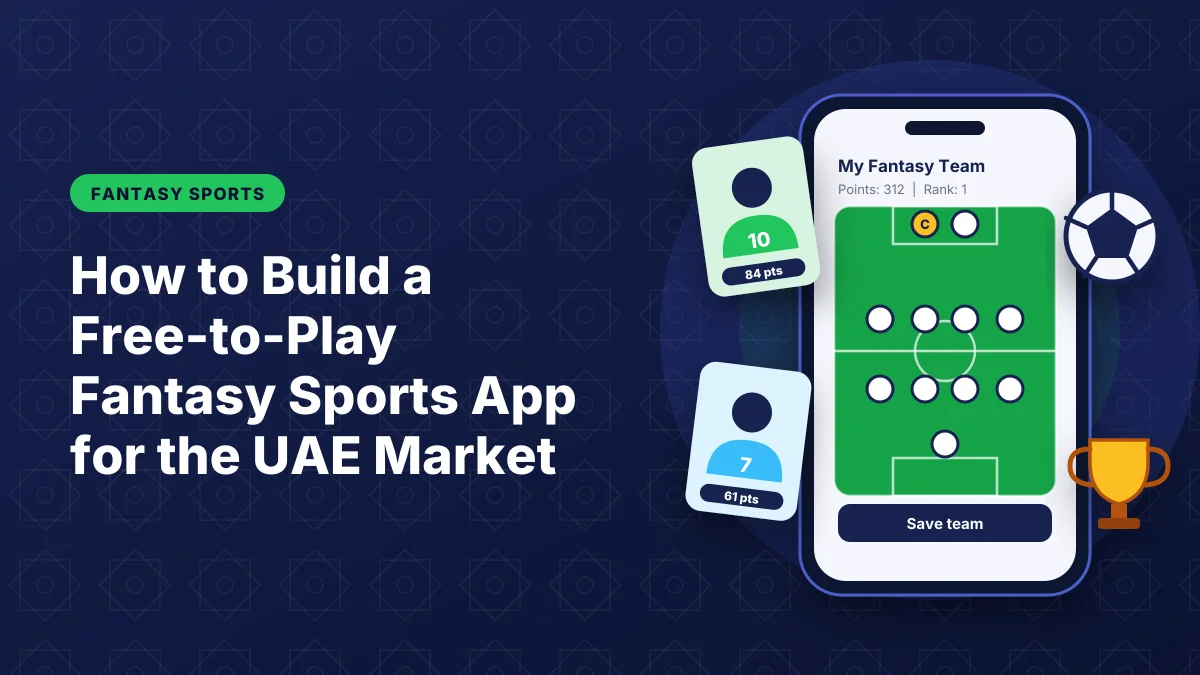
You can build a free-to-play fantasy sports app for the UAE, and it is usually the safer way into the market. Free-to-play means users pay nothing to enter and no cash changes hands on the outcome. That removes the biggest legal and app-store hurdles that real-money contests face. It does not remove them entirely, though, and the rules in the Emirates are still being clarified. This guide explains how to design, build and launch a free-to-play fantasy app for UAE users, what to check with a lawyer, and where the money comes from if players don't pay.
A word on what this article is. We are developers, not lawyers. We describe the regulatory picture as we understand it from public sources, and we say clearly where those sources disagree or stop. Please take advice from a UAE gaming lawyer before you launch. A fact sheet with sources is at the end.
Thinking of a free-to-play fantasy product for the Gulf? We'll help you scope it, shape the rules and plan the build. Talk to us or read about our fantasy sports app development.
Why free-to-play is the sensible starting point
There are three reasons most new fantasy products in regulated or uncertain markets begin free-to-play.
Lower legal exposure. Charging an entry fee and paying cash prizes can bring a product under gaming rules in many countries. A contest with no entry fee and no cash prize sits further from that line. How far depends on the law and on the details, which is why advice matters.
Easier app-store approval. Apple and Google both treat real-money gaming as a regulated category. Apple requires licences for each location, geo-restriction and free download; Google requires prior approval and licences too. A free-to-play game with virtual points generally avoids that path, although reviewers still look at how prizes work.
Cheaper and faster to build. No cash wallet, no withdrawals, no heavy identity checks, no payment-provider contracts. That shrinks both the budget and the risk of the first release.
There's also a business reason. Free play lets you build an audience and prove that people enjoy your game before you take on the weight of paid contests. If the audience arrives, you have options. If it does not, you have lost little.
The UAE regulatory picture, as far as public sources go
Please read this section as background, not a ruling.
A federal regulator now exists
The General Commercial Gaming Regulatory Authority (GCGRA) was set up in September 2023 as a federal body based in Abu Dhabi. It has exclusive power to license and supervise commercial gaming in the country. In late 2025, it granted its first licence for an online gaming and sports wagering platform, according to law-firm commentary.
The civil code changed in 2026
A new Civil Transactions Law, issued as Federal Decree-Law No. 25 of 2025, took effect on 1 June 2026. It replaced the 1985 law and did not carry forward the old chapter on gambling and betting contracts. Commentators link this to upcoming gaming-specific rules overseen by the GCGRA, and some expect related adjustments to criminal and cyber laws. That is interpretation, not settled fact.
The question that matters for you
Do the new commercial gaming rules reach a free-to-play fantasy game? The sources we reviewed describe the GCGRA's scope in broad terms, covering casino-style games, virtual sports and games of chance or mixed chance and skill offered online to people in the UAE. None of the commentary we found addressed fantasy sports, free-to-play or otherwise. The honest answer, as of writing, is that this needs legal advice based on the current text and any regulator guidance.
Questions to take to your lawyer
Does a free-to-play fantasy game with no entry fee fall under commercial gaming in the UAE?
Does it matter if prizes are non-cash, such as vouchers, merchandise or experiences? What if a sponsor funds them?
Does it matter if users can earn points that convert into rewards?
Do we need a licence, a registration or a notification, and from whom?
Are there rules on advertising and promotion of such games, including influencer posts?
What are the age and identity requirements?
Are there rules about running prize promotions or draws, and about permits from the Department of Economic Development in a given emirate?
How does the answer differ in Dubai, Abu Dhabi and the other emirates, and across free zones?
If we also serve Saudi Arabia or other Gulf states, what changes?
Bring a description of the product, the prize structure and the marketing plan. The more concrete you are, the more useful the advice.
Design to keep options open
Whatever the answer, you can design the product so it adapts. Keep the money-handling parts separate from the game logic. Make prize rules configurable by market. Build age gates and identity checks as modules you can tighten. That way, if the rules turn out stricter, or if you later want to add paid contests where permitted, you will not need to rebuild.
What "free-to-play" should mean in your product
Define the term before you design. We suggest a clear internal standard.
No entry fee. A user never pays to join a contest.
No cash prizes funded by users. Nothing a player pays creates the prize.
No purchase that affects the odds. If you sell anything, it must not buy a better chance of winning. Otherwise it starts to look like paying to play.
Prizes are clearly defined. If there are rewards, they are stated up front, with terms, and funded by you or sponsors.
Transparent rules. Everyone can see the scoring and the tie-break policy.
The third point is subtle and important. Selling extra team slots, boosters or premium entries can blur the line between free and paid play, so decide early whether you will sell anything, and run it past your lawyer.
Source: Arka Softwares delivery process.
Product design for a free-to-play fantasy app
Without entry fees, the thrill of winning money is gone, so the product has to work harder on fun, status and community.
Core loop
Pick a team before the match, watch it score, climb a leaderboard, return for the next fixture. The loop is the same as the paid version, but the reward is recognition, progress and, sometimes, a modest prize.
Private leagues first
Friends and colleagues competing for bragging rights is the strongest free-to-play hook. An office league, a WhatsApp group or a family rivalry brings in new users at no cost and keeps them coming back. Make creating and joining a league take seconds, with an invite link that opens straight into the right place.
Progress and identity
Levels and badges for streaks, correct captain picks, and season milestones.
Profiles and history so users can see how they have improved.
Season-long ladders that give a reason to play every match.
Achievements with clear, honest criteria.
Prizes, if you use them
Prizes help attract and retain users, but they raise legal questions, so keep them simple and documented. Options include sponsor-funded vouchers, experiences such as match tickets, merchandise, or recognition such as a featured-player slot. Write the terms in plain language: who is eligible, how winners are chosen, how they are notified, when prizes expire. Avoid anything resembling a draw or lottery unless your lawyer confirms the permissions needed.
Guidance for beginners
Many UAE users will be new to fantasy sports. Give them a short tutorial, a suggested starting team and plain-language tips. Our article how to build an AI-powered fantasy cricket app explains how suggestions and insights can help, and how to label them honestly.
Responsible play
Even without money, a game can be overused. Add reminders, session summaries and easy ways to mute notifications. Offer a visible link to support resources. It is good practice, builds trust and prepares you for stricter rules.
Age and identity
Set a minimum age that fits your legal advice and state it in the sign-up flow. Consider stronger checks for any reward that has value. Keep the checks modular.
Choosing sports for the UAE audience
Pick sports that match the people you want. In the Emirates, cricket has a very large following among South Asian communities, football draws a broad audience across nationalities, and there is growing interest in other sports. A sensible first launch focuses on one sport during its major tournament, with a second added later. Consider the calendar. Big events create demand, and your launch should land a few weeks before one.
Think about language, too. English will be your base, with Arabic essential for reach and trust. Depending on the sport, Hindi, Urdu, Malayalam and others can lift engagement. Our guide on Arabic localisation and right-to-left design explains how to avoid the common layout and translation mistakes.
Data and licensing
Even for a free game, you need live match data, and the licence matters. Many cheap data plans exclude commercial use, which can include ad-supported or sponsored apps. Tell providers precisely what you are building and get the answer in writing. Our companion piece, real-time sports API integration: architecture, costs and data licensing, covers how to compare providers, what licence terms to check and how to design the pipeline so you can switch suppliers.
Also check rules on team and league names, logos and player images. Using them without permission is a common cause of takedown notices. Many free-to-play games use generic imagery or licensed assets from their data provider.
Technology and architecture
The technical shape is similar to a paid fantasy app, minus the wallet and withdrawals.
Mobile apps: a cross-platform build (Flutter or React Native) to reach iOS and Android from one codebase. See Flutter vs React Native.
Backend: accounts, teams, leagues, scoring and leaderboards. See backend architecture explained.
Data pipeline: adapters, event model, scoring engine and replay.
Notifications: lineups, locks, results and invitations.
Admin panel: match setup, data corrections, support tools, content, prize management.
Analytics: funnels, retention and league growth.
Security: encryption, access control and logging. See mobile app security and data protection.
Plan for match-day spikes, even with free play. Free apps can attract very large concurrent crowds. Load test before the tournament. Our testing checklist helps.
A neat design trick: a prize-agnostic engine
Make the game engine agnostic about what a win means. A contest has entries, scores and ranks. What happens to the top ranks (a badge, a voucher, nothing) is handled by a separate module that reads the final leaderboard. That way, changing prize rules, adding a sponsor or switching off prizes in a given market becomes configuration instead of code change.
Cost and timeline
Free-to-play builds are cheaper than real-money builds, because the wallet, payment integration and identity layers shrink or disappear. As a guide from our current rates, a basic fantasy sports app typically falls around USD 7,200 to 10,800, with more advanced platforms around USD 14,400 to 18,000. These figures are indicative, for a single platform and exclude VAT, and the free-to-play model usually sits at the lower end of the range for the same feature count. Data licences, hosting, legal advice, marketing and support are extra. A typical timeline for an MVP is about three to five months.
For the full breakdown, read fantasy sports app development cost in 2027 and our regional piece, fantasy sports app development cost and features in the UAE.
How a free-to-play app makes money
If players don't pay to enter, revenue has to come from somewhere else. The main options:
Sponsorship. A brand sponsors a league, a tournament or a feature. The UAE has a large consumer-brand market, and sports audiences are attractive. Sponsorship works best once you can show an engaged audience.
Advertising. Banner or video ads in non-intrusive places. Quick to start, but it can annoy users and brings its own consent and data-protection duties.
Partnerships. Co-promotions with retailers, restaurants, telecoms or media companies who provide rewards in return for exposure.
Premium features. Optional extras such as advanced statistics, ad-free use or cosmetic customisation. Keep these away from anything that changes the chance of winning.
Data and insights. Aggregated, anonymised audience insight for partners, handled with care and with clear consent and legal approval.
White-label licensing. Offering the engine to media or sports brands who want their own branded game.
We compare these in more depth in mobile app monetization models that work in the UAE. Be realistic: free-to-play revenue arrives after the audience does. Budget to fund the first year without it.
Want a monetisation plan that fits a free-to-play model? We'll help you test sponsor, ad and premium options before you build. Book a call and bring your market and audience ideas.
App store approval for a free-to-play fantasy app
Store review is where many teams get caught, so prepare.
Describe the game honestly. Explain that it is free, uses virtual points and has no cash entry or cash prizes, if that is true.
Avoid gambling language. Terms like "bet", "wager" or "jackpot" invite scrutiny. Use "pick", "league" and "rank".
State prizes and rules clearly. Reviewers look for fair, transparent terms. Apple has specific rules on contests and promotions; read them.
No in-app purchases that look like paying to win. If you sell anything, keep it cosmetic or informational.
Age rating and content. Answer the questionnaires carefully and consistently.
Provide a demo path. Give reviewers an easy way to see a match and a contest working, even when no real match is live.
Prepare for questions. Have your legal position and prize terms ready in case the reviewer asks.
For the wider launch picture, see our App Store and Google Play launch checklist and the ASO guide.
Marketing in the UAE: what to watch
Promotion for games with prizes is more sensitive than for ordinary apps. Check the rules on advertising in the UAE, especially for influencer content and for anything that might suggest gambling. Be careful with claims such as "win big" or "earn money". Disclose sponsored posts. Follow platform rules on ads. And keep the tone about fun and competition.
On the practical side, community-led growth works well: office leagues, cricket clubs, university groups, expatriate associations, sports cafes and WhatsApp communities. We lay out a budget-friendly plan in how to get your first 1,000 app users. Time your push to a major tournament, and have a referral loop through private leagues so that each user brings in friends.
A step-by-step plan
Week 0: legal first. Brief a UAE gaming lawyer. Define free-to-play. Decide on prizes and sponsors.
Weeks 1 to 2: discovery. Pick the sport and the tournament. Write the scoring rules and the league design. Choose a data provider and get the licence in writing.
Weeks 3 to 4: design. Wireframes and visual design. Test the team builder and league flows with real users. See our UI and UX guide.
Weeks 5 to 14: build. Scoring engine and data pipeline first. Then apps, leagues, notifications and admin.
Weeks 12 to 16: test. Replay past matches, load test, security review, Arabic and English quality checks.
Weeks 14 to 18: store submission. Prepare listings, privacy details and the review notes.
Soft launch. Invite a few hundred users, watch a few matches, fix issues.
Public launch, a few weeks before the tournament. Push on community channels and sponsors.
After launch. Review metrics, listen to users and plan phase two.
The week numbers are a planning illustration. Your real schedule depends on scope, decisions and store review.
Sponsor-funded prizes: how to set them up cleanly
Sponsor-funded rewards are the most common way free-to-play games add stakes without taking entry fees. They are also where small mistakes cause big headaches, so it pays to be methodical.
Get the sponsor agreement in writing. State what the sponsor provides, who fulfils it, the dates, and who is responsible if a prize can't be delivered.
Publish the terms before the contest opens. Eligibility, how winners are picked, tie-breaks, how they will be contacted, how long they have to claim, and what happens to unclaimed prizes.
Keep selection mechanical. Rank by score, with a stated tie-break such as the earlier team submission. Avoid anything that looks like a random draw unless you have confirmed the permits you need.
Verify winners. Check age and residency where your terms require it, and keep records.
Separate the sponsor from the game. The sponsor funds the reward. The ranking is produced by your engine. Your terms should say the sponsor has no influence on results.
Keep an audit trail. Final leaderboards, tie-break decisions and winner notifications, stored for as long as your lawyer advises.
Tell people the truth about odds. If a prize goes to the top ten out of fifty thousand, say so. Honest framing builds trust.
This is also a good place to repeat the lesson from earlier: keep the prize module separate from the scoring engine. If a sponsor leaves, or a regulator asks you to change how rewards work, you switch the module, not the game.
What a first-month launch week looks like
To make the plan tangible, here is how the first week after a soft launch usually runs for a product like this.
Day 1: invite a seed group, such as a club or a workplace community, and ask each person to create one private league. Watch sign-up completion and time to first team.
Days 2 to 3: run the first live match. Have an engineer on call, a data-feed dashboard open and a prepared message in case the feed lags.
Day 4: read every support message and every review. Tag them: bug, confusion, request. Fix the top three.
Day 5: review the numbers for leagues created, invites accepted and return rate. Adjust the onboarding copy if people stall.
Days 6 to 7: run the second match, compare errors with the first and publish a short note to users about what you changed. Visible responsiveness is a growth tool.
A calm, well-documented first week teaches you more than a splashy launch with no safety net.
Metrics to watch
Sign-up completion and time to first team
Teams created per match
Private leagues created and average members per league
Day-1, day-7 and day-30 return
Invites sent and accepted
Notification opt-in and opt-out rates
Support tickets per thousand users
Crash-free sessions
Sponsor and ad performance once you have them
Private leagues per active user is often the best sign that the game is spreading by itself.
Keeping the door open to paid contests later
Many founders start free-to-play with a quiet plan to add paid contests if the law allows. That can be sensible, but only if you prepare in the right places and avoid over-building in the wrong ones.
What to prepare now: a clean separation between game logic and money logic, a configuration system for rules by country, an identity-verification module that can be switched on, a responsible-play toolkit and a data licence that anticipates a broader use. What not to build yet: a cash wallet, payout flows and a payment-provider integration that you may never use. They add cost, security exposure and store-review questions long before they add revenue.
Also be honest with yourself about the audience. Users who joined for free social play may not want to pay, and a sudden shift can upset the community you worked to build. If you do introduce paid features one day, add them as clearly separate options, explain the change and keep the free experience alive.
Common mistakes
Assuming "free" means "unregulated". Check, with advice.
Adding paid boosters that blur the line. Keep purchases away from the odds.
Vague prize terms. They cause disputes and attract scrutiny.
Ignoring Arabic. It limits reach and trust.
Using a non-commercial data plan. Check the licence.
Skipping load tests. Free apps draw crowds.
Launching after the tournament. Time matters.
No plan for revenue. Free users need a business model behind them.
Frequently asked questions
Is a free-to-play fantasy sports app legal in the UAE?
It depends on the details and on rules that are still being clarified. A federal regulator, the GCGRA, oversees commercial gaming, and public commentary does not clearly address free-to-play fantasy games. Take legal advice on your specific model before launching.
Can I offer prizes?
Possibly, such as sponsor-funded vouchers or experiences, but prizes raise additional questions about permits and promotions. Ask your lawyer and write clear terms.
Will Apple and Google approve a free-to-play fantasy app?
Generally the path is simpler than for real-money games, because it avoids licensing requirements for gambling apps. Reviewers still check how prizes and purchases work, so be transparent.
How much does it cost?
With us, a basic fantasy sports build is typically around USD 7,200 to 10,800 for one platform, excluding VAT, with free-to-play usually at the lower end for the same scope. Data, hosting, legal, marketing and support are extra.
How do I make money if users don't pay?
Sponsorship, advertising, partnerships, optional premium features and white-label licensing. Expect revenue to follow audience growth.
Can I add paid contests later?
Possibly, where the law and the stores allow it, and with the right licences. Design the product so that payment and compliance modules can be added later.
Which sport should I start with?
Choose the one with the strongest audience in your target community and a major tournament coming soon. Cricket and football are common starting points in the Gulf.
Final thoughts
A free-to-play fantasy app is a sensible way to enter the UAE market: lower risk, faster to build and easier to get through the stores. But it is not a loophole. The rules are changing, the details of your prizes and purchases matter, and the first thing to buy is advice from someone who knows the law. Build a strong core game, make private leagues effortless, treat Arabic as a first-class language, and design the system so that prizes, payments and compliance can change without a rebuild.
If you'd like a hand scoping it, reach us on the contact page, or explore our mobile app development services.
Fact sheet and sources
The facts below are from outside sources, as of the dates we checked them. Laws change, so confirm with a qualified UAE lawyer.
Fact | Source |
|---|---|
The GCGRA was established on 3 September 2023 as a federal body in Abu Dhabi with exclusive jurisdiction to license and supervise commercial gaming. | |
The new Civil Transactions Law (Federal Decree-Law No. 25 of 2025) took effect on 1 June 2026; the old gambling and betting articles were not carried forward. | Greenberg Traurig: UAE civil code gambling provisions removed |
GCGRA licensing scope is described as covering casino-style games, virtual sports and games of chance or mixed chance and skill offered online. Sources reviewed did not address fantasy sports. | |
Apple requires real-money gaming apps to hold licences per location, be geo-restricted and be free to download; in-app purchase may not be used for real-money gaming credits. | |
Google Play allows real-money gambling apps only if licensed and approved by Google, free to download and restricted by age and location. Daily fantasy sports apps are permitted only where local law allows. | |
India's 2025 online gaming law pushed many fantasy platforms toward free and social formats. | Ken Research (secondary; confirm against the Act) |
Basic fantasy sports app: USD 7,200 to 10,800; advanced: USD 14,400 to 18,000; indicative, single platform, excluding VAT. MVP timeline about 3 to 5 months. | Arka Softwares pricing, October 2026 |