If you want to build a fantasy cricket app that people keep opening after the first match, the short answer is this: get the core game right, buy reliable live data, and add AI only where it saves a user real effort. AI on its own will not make an average fantasy app good. A clean team builder, fast scoring and honest rules will. AI is the layer that makes those things easier to use and cheaper to run.
This guide walks through how we would approach the build, from the first scoping call to the first live match. It covers the features you need, where machine learning earns its place, how the architecture holds up on match day, what the data costs, and how the rules of the UAE and the app stores shape your plan. A fact sheet with outside sources sits at the end, so you can check the numbers we lean on.
Planning a fantasy cricket product? Tell us your target market and we'll send a scoped plan with a timeline and a price range. Share your idea on the contact page or see our fantasy sports app development page.
What a fantasy cricket app actually is
A fantasy cricket app lets people pick a virtual team of real players before a match. As those players score runs, take wickets and make catches in the real game, the user's team earns points. Users compete in contests, either against friends in private leagues or against strangers in public ones, and the highest-scoring teams top the leaderboard.
That sounds simple, and the first version of the idea is. The hard part is everything around it. Scores change every ball. Thousands of users hit the app in the ten minutes before a toss. A single wrong point calculation can start an argument that takes a support team a week to settle. So most of the engineering effort goes into reliability, not novelty.
Cricket has some quirks that make it different from football or basketball. There are three formats with different rhythms: T20, one-day and Test. Matches can be delayed by rain and shortened by a rules formula. A player can be in the squad but not in the playing eleven until the toss, which means the lineup is not final until close to start time. Your product design has to cope with all of this without confusing people.
Who plays, and why it matters for design
Before you draw a single screen, decide who the first user is. Fantasy cricket draws a few quite different groups:
- The casual fan. Watches a few big matches a year. Wants to pick a team in two minutes and feel clever. Needs help.
- The regular. Plays most days during a tournament. Knows the players, reads the pitch report, and checks the lineup before the toss. Wants control and speed.
- The group organiser. Runs a league for an office or a WhatsApp group. Cares about invites, a clean leaderboard and no cheating.
- The expert. Treats it as a craft. Wants stats, filters and the ability to build many teams.
The casual fan and the regular want opposite things, and an app that tries to serve everyone on one screen usually serves nobody. A common pattern is a guided path for newcomers and a dense "pro" view that appears after a few contests. AI helps here, which we'll get to.
In the Gulf the audience has its own shape. A large share of cricket followers in the UAE and Saudi Arabia are South Asian expatriates, with a growing group of local fans. That affects language (English, Hindi, Urdu, Arabic and Malayalam all show up), match timing (many big fixtures are in the evening Gulf time) and payments. If you are planning for the region, our guide on Arabic localisation and right-to-left design is worth reading early, because retrofitting it is painful.
Start with the rules, not the code
Before the technology, settle the product rules. These decisions touch everything, and changing them later is expensive.
Choose your contest model
There are three broad shapes:
- Free-to-play. No money to enter, prizes are non-cash or sponsor-funded. Lowest regulatory risk, and the easiest to get into the app stores. Revenue comes from advertising, sponsorship or premium features.
- Entry-fee contests with cash prizes. The classic model in India before 2025. Highest revenue potential and highest legal exposure. In many places it is restricted or banned.
- Subscription or pass-based. Users pay for access to tools, insight or a season pass rather than to enter individual contests.
We are not lawyers and nothing here is legal advice. But we have seen projects stall because the business model was chosen first and the law checked last. Pick the model with your legal adviser, in the specific countries you plan to serve, before you commission design. We go deeper on the UAE side in a separate piece, how to build a free-to-play fantasy sports app for the UAE market.
Write the scoring rules in plain language
Every fantasy cricket product has a points table: so many points per run, per wicket, per catch, a bonus for a half-century, a penalty for a duck. Different formats usually get different tables. Write yours as a document first, with worked examples, and have someone who isn't an engineer read it. If they can't predict how a six affects the score, your users won't either.
Then build the scoring engine as a standalone service with a long list of automated tests, one for every rule and for the odd cases: a player retired hurt, a super over, a match reduced by rain, a wicket by run-out where credit is shared. This is the part of the app that must never be wrong.
Define the contest lifecycle
A contest moves through states: open for entries, locked at the toss, live, under review, settled. Each transition needs a clear trigger and a record. Locking is the one users argue about most, so decide the exact moment (scheduled start time, or the actual toss), say so in the app, and log it.
The features you need on day one
A minimum viable fantasy cricket app is smaller than people expect, but "minimum" still means a complete loop. A user must be able to sign up, pick a team, join a contest, watch it update, and see the result. Here is what that loop usually includes.
Accounts and onboarding
Phone-number sign-in with a one-time code is the norm in the region and keeps friction low. Add age confirmation and any identity checks your legal model requires. Keep onboarding to a few screens and let people browse matches before they register, because the sooner they see a live contest the sooner they care.
Match centre
A list of upcoming, live and completed matches, with squads, venue, format and a countdown to lock time. Each match page leads into its contests.
Team builder
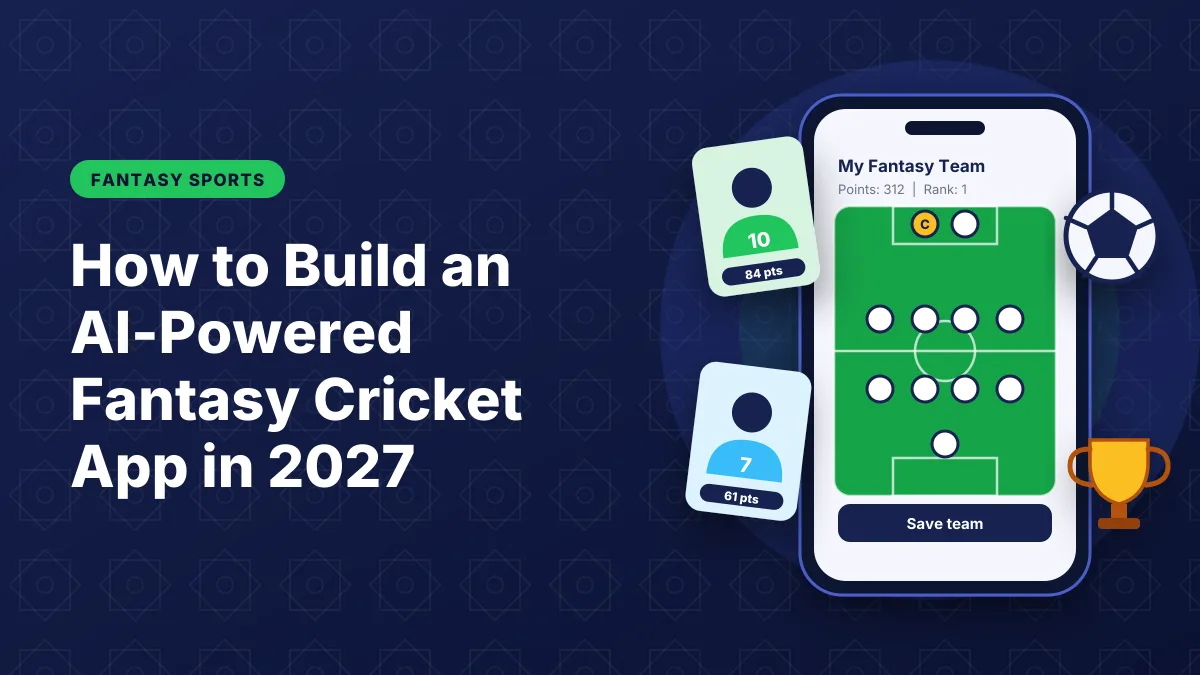
This is the heart of the product. The user has a budget (often a credit cap), a limit per real team, role rules (wicketkeeper, batters, all-rounders, bowlers) and then picks a captain and vice-captain who earn bonus points. Make it fast to use with one hand. Show each player's role, recent form and credit cost. Warn clearly when a rule is broken, and say which one.
Contests and leaderboards
Public and private contests, entry limits, invite links and a leaderboard that updates during the match. For private leagues, give the organiser an invite code and basic controls. Group play is where a lot of organic growth comes from, so it deserves real design time.
Live scoring
Points update as the match progresses, ideally within seconds of each ball. Show each player's contribution and the user's rank. This screen gets the most traffic and the most scrutiny.
Wallet, rewards or points
Depending on your model, this may be a cash wallet, a points balance or a rewards store. If real money is involved, it needs proper ledger design, payment-provider integration and reconciliation. If not, a simple points ledger is enough. See UAE mobile app payment options for the regional landscape.
Notifications
Lineup announced, contest about to lock, your team is leading, results ready. Notifications drive repeat play, but too many drive deletions. Let people choose.
Admin panel
Operations staff need to create matches and contests, correct data, handle support cases, review suspicious accounts and pull reports. Teams often underbuild this and then run the business out of the database. Plan for it from the start.
Want a feature list matched to your budget? We'll map your must-haves and nice-to-haves into a phased plan. Book a call and we'll walk through it with you.
Where AI genuinely helps
"AI-powered" gets slapped on everything, so let's be specific. In a fantasy cricket app there are six places where machine learning or language models do real work. For each, we note the benefit and the catch.
1. Team suggestions for beginners
A new user stares at 22 players and a credit cap and freezes. A suggestion engine can offer a starting team based on recent form, role balance, venue history and the opposition. The user can accept it, tweak it or ignore it.
The catch: be honest that this is a suggestion, not a prediction of the winner. Sport has randomness, and promising an edge you can't deliver damages trust and, in some places, can raise consumer-protection issues. A good label is "a balanced starting team", not "the winning team".
Technically, this can start as a simple scoring model that ranks players by a weighted mix of recent output, role, venue and matchup, with a constraint solver to fit the credit cap and role rules. You don't need a deep neural network for version one. A well-designed heuristic with a few features often performs as well and is far easier to explain and debug.
2. Player insight in plain language
Stats tables are for experts. Most people want a sentence: "He has scored fifty-plus in three of his last five at this ground." A language model can turn structured data into short, readable notes on each player and each match, which makes the team builder friendlier.
The catch: language models can state wrong things confidently. The safe design is to compute the facts from your own database and let the model only phrase them, not invent them. Keep a check that every number in the generated text exists in the source data. Where a claim can't be checked, drop it.
3. A conversational assistant
Some apps add a chat helper that answers "who should I captain tonight?" or "explain how bonus points work". Used well, it lowers the learning curve and reduces support tickets. The rules questions are the most valuable, because the answers are fixed and checkable.
The catch: cost and risk. Every chat turn costs money, and open-ended chat invites strange requests. Limit its scope, ground it in your rules and data, rate-limit it and log it. On the regulatory side, don't let it give anything that looks like betting or financial advice.
4. Fraud and abuse detection
This is often the highest-return use of machine learning in the whole product. Multiple accounts run by one person, collusion in private contests, bots, bonus abuse and payment fraud all drain money and destroy fairness for honest players. Models that look at device signals, behaviour patterns, account linkages and unusual timing can flag cases for human review.
The catch: false positives hurt real users. Treat the model as a triage tool that raises a flag, and keep a person in the loop for any action that blocks money or an account. Document the rules so you can explain decisions.
5. Personalisation and retention
Which matches does this user care about? Which contest sizes do they join? When do they usually play? A light recommendation model can surface the right contest at the right time and time notifications to the user's habits. This is useful but secondary; get it after the core loop works.
6. Support automation
A large share of tickets are the same questions: where is my result, why did I lose points, how do I withdraw. A grounded assistant can answer these and hand complex cases to a person. It saves operations cost, which matters as you scale.
What we'd leave out of version one
Skip anything that claims to predict match outcomes with high accuracy, and skip features that depend on data you don't have yet. Models need history, and a new app has none. Start with transparent rules and commercial data, collect your own behavioural data from real users, and add learned models once you have enough of it.
Source: Arka Softwares typical timelines, from kick-off to launch. Scope changes the timeline.
Architecture that survives match day
Fantasy apps have a peculiar traffic shape. Quiet most of the day, then a surge just before a toss, then steady heavy reads during the match, then a spike at the end for results. If you design for the average, you'll fail at the peak. Here is the structure we'd use, in plain terms.
The pieces
- Mobile apps. iOS and Android. Cross-platform frameworks such as Flutter or React Native work well here and cut cost. Our comparison, Flutter vs React Native for UAE businesses, helps you choose.
- API layer. Handles sign-in, teams, contests and wallet. Stateless, so you can add more instances when traffic rises.
- Data ingestion service. Pulls live match data from your provider, normalises it and publishes events. This is the bridge between the outside world and your system.
- Scoring engine. Consumes match events and calculates fantasy points per player, then per user team.
- Leaderboard service. Keeps ranks for each contest, usually in an in-memory store that handles fast sorted updates.
- Real-time delivery. Pushes updates to the apps through WebSockets or server-sent events, with a polling fallback.
- Primary database. A relational database for users, teams, contests and ledgers, where correctness matters most.
- Queue and workers. For notifications, settlement, emails and anything slow that shouldn't block a request.
- Admin and reporting. Internal tools and analytics.
- AI services. Suggestions, insights, assistant and fraud scoring, kept separate so you can scale and change them on their own schedule.
For a fuller picture of how the back end fits together, read mobile app backend architecture explained.
The data flow for one ball
- The provider reports that a batter hit a four.
- Your ingestion service receives it, checks it for duplicates and order, and publishes an event.
- The scoring engine updates that player's fantasy points.
- Every user team containing that player is re-scored, either immediately or in batches of a second or two.
- Leaderboards update.
- Connected apps get the new numbers.
Step four is where scale bites. If a popular player is in 400,000 teams, one boundary triggers 400,000 recalculations. The standard trick is to compute player points once, then derive team totals from them with cheap arithmetic, and to batch leaderboard writes. Don't recompute from scratch for each user.
Idempotency and corrections
Data providers sometimes correct a score after the fact: a run reassigned, a catch credited to a different fielder. Your pipeline must handle events arriving twice, out of order or revised. Store the raw events, build points from them deterministically, and be able to replay a match. That also gives you an audit trail when a user disputes a result.
Handling the lock-time spike
The last minutes before a contest locks are the heaviest for writes: people rushing to finish teams and join contests. Prepare for it with load testing that mimics the pattern, queue-based writes where you can, rate limits that protect the core, and a clear "try again" experience instead of a spinner. Do this testing before your first big tournament, not during it. Our mobile app testing checklist covers the wider testing picture.
Security and data protection
You'll hold personal details, possibly identity documents and payment information. Encrypt data in transit and at rest, limit who in your team can see it, and log access. If you serve users in the UAE, review local data-protection rules; we cover the essentials in mobile app security and data protection in the UAE.
Live cricket data: your biggest dependency
Your app is only as good as its data feed. If it lags, mistakes a wicket or goes down mid-over, users lose trust fast. There are three broad sources.
- Official or primary data rights holders. The most accurate and the most expensive, usually sold to larger operators on commercial terms.
- Specialist sports-data API providers. Many companies sell cricket feeds with ball-by-ball data, squads and player statistics, often with tiered plans.
- Scraping public sites. Don't. It's unreliable, usually breaches terms of service and exposes you to legal claims.
Pricing varies widely, from low monthly plans for hobby use to custom contracts for commercial products. What a provider lets you do with the data matters as much as the price, and many cheaper plans prohibit commercial use or redistribution. Read the licence before you build on it. We cover the technical and commercial sides in our companion article, real-time sports API integration: architecture, costs and data licensing.
Two practical tips. First, use more than one source if your budget allows, so you can cross-check a disputed event and fail over if one feed drops. Second, build an abstraction layer so that switching providers means changing one adapter, not rewriting your scoring engine.
Not sure which data provider fits? We've integrated live feeds into several products and can help you compare options against your budget and licence needs. Ask our team.
Designing for trust
People play fantasy sports because they enjoy the competition. They quit because they feel it was unfair or confusing. Trust is a product feature, and it's built from small things.
- Show your rules, always. One tap from any contest to the points table and the lock policy.
- Explain every point. A breakdown per player lets users check the maths themselves.
- Be clear about delays. If a match is paused, say what happens to the contest.
- Handle disputes quickly. A visible way to raise an issue and a fast, polite answer.
- Be honest about AI. Label suggestions as suggestions. Don't imply guaranteed outcomes.
- Offer responsible-play tools. Limits, cool-off options and links to support. This is the right thing to do, and the app stores and regulators increasingly expect it.
Compliance and store approval
The most common reason fantasy products stall is not the technology but the rules. Two layers matter: the law where your users live, and the policies of Apple and Google.
The law
Gaming law is changing quickly across the region and beyond. In India, for example, the Promotion and Regulation of Online Gaming Act of 2025 reshaped the real-money fantasy market, pushing many platforms toward free and social formats. In the UAE, a federal body, the General Commercial Gaming Regulatory Authority (GCGRA), was set up in 2023 to license and supervise commercial gaming, and the country's updated civil code, effective from 1 June 2026, no longer carries the old gambling chapter. Details are still emerging, including how fantasy formats are treated, so take current advice from a local lawyer before you decide on a paid model. Treat anything you read online, including this article, as a starting point rather than a ruling.
The app stores
Apple's guidelines treat real-money gaming as a regulated category: apps need the proper licences in each place they operate, must restrict access to those places, and must be free to download. Google Play has its own policy for real-money games and contests, with a prior approval step and licence requirements by jurisdiction. Free-to-play formats that use virtual points face fewer hurdles, though reviewers still look closely at how prizes work. Read the current policy text on each store's site before you finalise your model, because these pages change.
Age and identity
Whatever the model, plan for age gates and, where needed, identity verification. Build it so the checks can tighten without a rebuild.
Cost and timeline
Costs depend on scope, the number of platforms, the contest model and how much AI you include. As a rough guide from our current pricing, a basic fantasy sports app typically sits around USD 7,200 to 10,800, and an advanced platform with deeper features, scale work and richer admin tooling around USD 14,400 to 18,000. These figures are indicative, for a single platform and exclude VAT. Live data licences, payment-provider fees, AI usage, cloud hosting and legal costs come on top, and can exceed the build cost in the first year if you scale quickly. Our detailed breakdown is in fantasy sports app development cost and features, and we compare tiers in fantasy sports app development cost in 2027: MVP vs advanced platform.
For a sense of schedule, an MVP often takes three to five months and a more advanced build five months or more, depending on how quickly decisions are made. The biggest schedule risks are late changes to rules, slow data-licence negotiations and store approval. Start those conversations in the first month, not the last.
A sensible phasing
- Phase 1: core loop (MVP). Sign-in, match centre, team builder, one or two contest types, live scoring, leaderboards, simple admin. Rule-based team suggestions.
- Phase 2: engagement. Private leagues, notifications, referral, richer stats, player insight notes.
- Phase 3: intelligence. Fraud scoring, personalisation, conversational help, support automation.
- Phase 4: scale and expansion. More sports, more languages, more markets, deeper analytics.
This order keeps early spend focused on what proves the product, and defers AI features that need data you don't yet have.
A launch plan that fits a cricket calendar
Timing matters more in fantasy sports than in most categories. Big tournaments create the demand, and a launch just after one ends can leave you waiting months for traffic. Aim to be live and stable a few weeks before a major event, with enough buffer to fix problems found in smaller matches first.
- Soft launch with a small group. Invite a few hundred people, run a handful of matches and watch for scoring errors and slow screens.
- Fix, then widen. Resolve what you found. Open the doors gradually.
- Prepare support. Have answers ready for the top ten questions, a response-time target, and an escalation path.
- Get the store listing right. Our app store optimisation guide and launch checklist help here.
- Plan your first thousand users. See how to get your first 1,000 app users.
How to make money without cheapening the product
If your model is free-to-play, revenue usually comes from a mix of sponsorship, advertising, partnerships with brands and optional premium features such as advanced stats or ad-free play. Each has trade-offs: ads can annoy, sponsors want reach, premium needs real value. We compare options in mobile app monetization models that work in the UAE. Whatever you choose, test it with real users early, because what looks good on a spreadsheet often fails on a phone.
Common mistakes we'd steer you away from
- Starting with AI instead of the game. Fancy suggestions on top of slow scoring will not save you.
- Underestimating data licensing. A cheap plan that bans commercial use is a trap.
- Skipping load tests. The first big match is not the time to find your limits.
- Vague rules. Ambiguity breeds disputes.
- Ignoring the admin side. Support and operations will drown without tools.
- Choosing the legal model last. It shapes the product, the stores and the budget.
- Overpromising. No tool can promise winners. Claims you can't back up create risk.
- Launching at the wrong time. Align with the calendar.
How we'd run the project
Here is how a typical engagement with us unfolds, so you know what to expect. It follows the same shape as our general mobile app development process, with extra care around data and load.
- Discovery. We settle the market, the contest model, the scoring rules and the data source. You get a written scope and a rough estimate.
- Design. Wireframes and visual design for the key flows, tested with real users where possible. See our UI and UX design guide.
- Build in short cycles. You see working software every couple of weeks, starting with the scoring engine and data pipeline because they carry the most risk.
- Test hard. Rule tests, replay of past matches, load tests and a security review.
- Launch and learn. Soft launch, monitor, fix, widen.
- Support and grow. Ongoing maintenance, which typically costs 15 to 20% of the build per year; see mobile app maintenance cost.
Before you sign with any vendor, including us, read our contract checklist. It lists what to confirm on ownership, source code, data and support.
Ready to scope it properly? Send us the market, the format and your rough budget, and we'll reply with an honest view of what's realistic. Start the conversation or book a call.
Frequently asked questions
How long does it take to build a fantasy cricket app?
A focused MVP usually takes about three to five months. A fuller platform with more contest types, AI features and heavy admin tooling takes five months or more. Data licensing and store approval can add weeks, so begin them early.
Do I need AI in the first version?
No. A rule-based team suggestion and good live scoring are enough to launch. Add learned models once you have real user data to train and test them on.
Can I use a free cricket API?
Free plans are fine for prototyping. Most prohibit commercial use or have strict limits, so check the licence before you launch publicly.
Is fantasy cricket legal in the UAE?
That depends on the model and on rules that are still being clarified. Get advice from a UAE gaming lawyer before you choose how contests and prizes work.
Will Apple and Google approve my app?
Free-to-play apps with virtual points are generally simpler to get through. Real-money formats need licences and, on Google Play, prior approval. Read each store's current policy before you commit.
How do I stop cheating?
Combine device and behaviour signals, account linking checks and human review. Keep the rules clear and enforce them consistently.
From our portfolio: a fantasy cricket app we built
This guide draws on public sources, but we have also built in this category. Jeeto 11 is a fantasy cricket mobile app our team delivered in three months with a six-person team (business analyst, project manager, developers, designers and QA). It offers public and private leagues, play against strangers or friends, and cash prizes, on a stack of ASP.NET, MSSQL, Java and Android. The challenges listed on the case study are the same ones we describe above: stiff competition from other fantasy apps, keeping users, and promotion. The answers were new features, rewards and a referral programme. According to the client's review, the app passed 1,000 downloads within two months of launch. That's a modest number, and we mention it for the same reason we mention everything else here: it's what the client said, not a projection. Cash-prize contests like these depend on the legal position of the market they run in, which is why we start the UAE and Saudi guides with the law.
Source: Arka Softwares delivery process.
Final thoughts
A good fantasy cricket app is part sports product, part real-time system and part trust exercise. The AI layer is valuable, but it works best as a helper that makes the game easier to enter and fairer to play, not as a headline. Get the rules, the data and the scoring right. Stay honest with your users. Add intelligence where it saves them effort or protects them from abuse. And treat the law and the store policies as part of the design, not an afterthought.
If you'd like help turning this into a real product, we'd be glad to talk. Share your plans on the contact page, or read about our mobile app development services.
Fact sheet and sources
The facts below come from outside sources, checked on the dates shown. Pricing figures marked "Arka" are our own indicative rates. Please verify anything legal or commercial with a professional before acting.
| Fact | Source |
|---|---|
| The UAE's GCGRA was established in September 2023 as a federal body to license and supervise commercial gaming. | Legal 500 (Mondaq): UAE commercial gaming law |
| The new UAE Civil Transactions Law (Federal Decree-Law No. 25 of 2025) took effect on 1 June 2026 and did not carry forward the old gambling and betting articles. | Greenberg Traurig: UAE civil code gambling provisions removed |
| Apple requires real-money gaming apps to hold licences for each location, to be geo-restricted and to be free to download. | Apple App Store Review Guidelines, section 5.3 |
| Google Play restricts real-money gambling apps to those licensed and approved by Google, and sets conditions such as being free to download and blocking minors and unauthorised locations. | Google Play policy: Real-Money Gambling, Games and Contests |
| India's Promotion and Regulation of Online Gaming Act, 2025 shifted the fantasy market toward free and social formats. | Ken Research: India fantasy sports market (secondary; confirm with the Act's official text) |
| Estimates of India's fantasy user base range from about 138 million annual active users to more than 230 million registered users, depending on the source. | Ken Research |
| Apple's Foundation Models framework gives apps access to the on-device model behind Apple Intelligence. | Apple Developer documentation: Foundation Models |
| Gartner expects over 40% of agentic AI projects to be cancelled by the end of 2027, citing cost, unclear value and weak risk controls. | Gartner press release, 25 June 2025 |
| Basic fantasy sports app: USD 7,200 to 10,800. Advanced: USD 14,400 to 18,000. Indicative, single platform, excl. VAT. | Arka Softwares pricing, October 2026 |
| Maintenance typically costs 15 to 20% of the build per year. | Arka Softwares pricing, October 2026 |