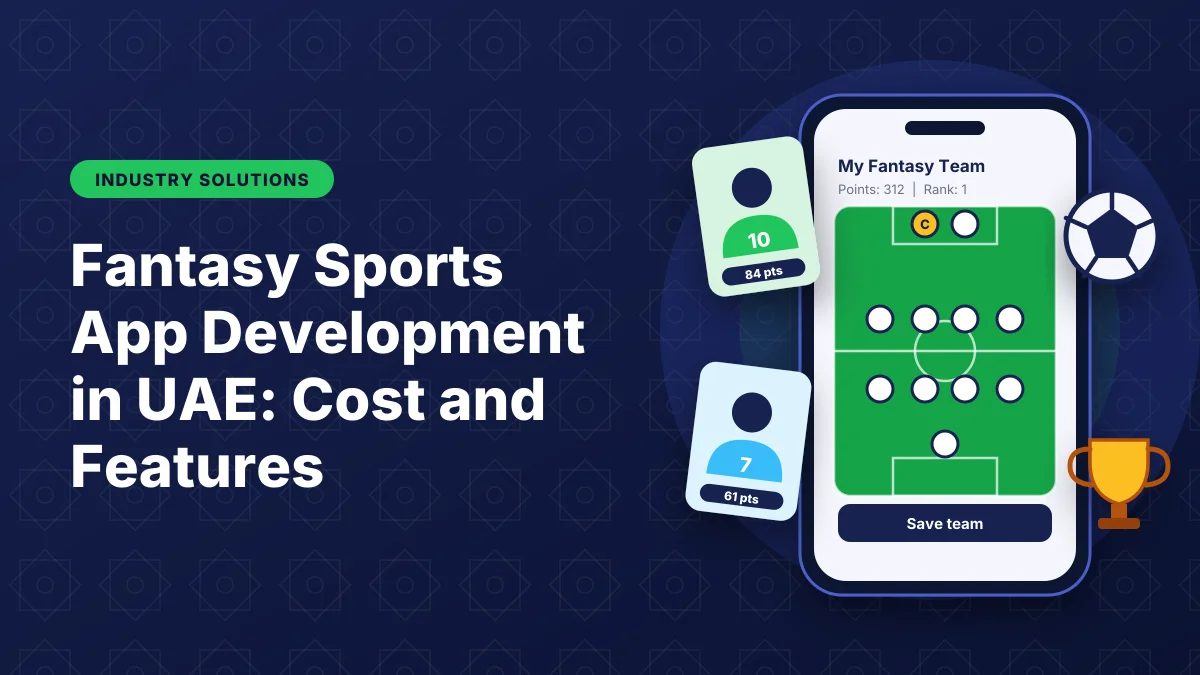
Fantasy sports app development is one of the most interesting product categories for sports, media and entertainment businesses in the UAE. Fans in Dubai, Abu Dhabi, Riyadh and Doha already follow cricket, football and other leagues closely, and a fantasy app turns watching into playing: users build virtual teams of real players, earn points from real match performance and compete with friends. This guide explains how a fantasy sports app works, the features it needs, the technology behind it, what it costs, the rules you must check in the UAE, and how to build and launch one without wasting budget.
It is written for founders, sports organisations, media companies and brands who are deciding whether to build a fantasy product, and for product owners who already know they want one and need a realistic plan. We cover the full journey, from the first idea to the first live match, and we are open about what is difficult, because most fantasy apps fail on data, fairness and retention rather than on screens.
Key takeaways
- A fantasy sports app has three layers: the user app, the scoring and data engine, and an admin panel. Most of the effort and risk sits in the second and third layers, not in the screens users see.
- At Arka Softwares, a basic fantasy sports app typically costs USD 12,000 to 18,000 and an advanced one USD 24,000 to 30,000, for a single platform and excluding VAT. Live data licences, extra sports and integrations are the main cost drivers after the core build.
- Gambling and betting are generally prohibited in the UAE, so the practical model is a free-to-play fantasy or prediction game. Plan prizes, rewards and payments with a UAE lawyer before you design the wallet.
- Start with one sport, usually cricket or football, prove that users come back every match day, and only then add more sports and contest types.
- Retention, fairness and match-day reliability decide whether the app succeeds. Design for them from the first sprint.
What is a fantasy sports app?
A fantasy sports app lets users act as the manager of a virtual team. Before a match or season starts, the user selects real players within rules set by the app, such as a budget, a number of players per team or a position limit. As the real match is played, the app converts each player's actual performance into fantasy points using a published scoring system. The user's team total decides their rank in a contest, and the best performers climb a leaderboard and earn rewards defined by the contest.
The appeal is simple. Fantasy gives every match a personal stake, even when the user's favourite club is not playing. It rewards knowledge of the sport, it is social because users compete with friends and colleagues, and it brings fans back on every match day instead of only when their own team plays. For a sports organisation, broadcaster or brand, that repeated engagement is the real product.
A typical user journey
- The user signs up with a phone number, email or social account and chooses a username.
- They see upcoming matches and pick a contest, such as a public contest or a private league with friends.
- They build a team inside the budget or point limit and choose a captain and vice-captain whose points count extra.
- They join the contest and receive a reminder before the match starts, when teams lock.
- During the match, points update from live data and the leaderboard moves.
- After the match, the app finalises points, publishes results, awards rewards and invites the user to the next contest.
Every step in that journey needs design, data and testing, and every step is a chance to lose the user. That is why a good fantasy app feels simple on the surface and is carefully engineered underneath.
Source: Arka Softwares typical timelines, from kick-off to launch. Scope changes the timeline.
Fantasy sports, betting and prediction games: the difference
These three products are often confused, and the difference matters both for your design and for your legal position.
- Fantasy sports. Users build a team of real players and score points from their real statistics. Success depends on knowledge of the sport, team selection and, to some extent, luck.
- Prediction or pick'em games. Users predict outcomes, such as the winner of a match or the top scorer, and earn points for correct answers. They are easier to build and play, and they work well for casual fans and for sponsors.
- Betting. Users stake money on an outcome and win or lose money depending on the result. This is a separate regulated activity and is generally prohibited in the UAE.
Because real-money betting is not an option for most UAE businesses, the models that work are free-to-play fantasy and prediction games, usually supported by sponsors, advertising, subscriptions or brand partnerships. We cover the rules in detail later in this guide.
Types of fantasy sports apps you can build
Choosing the format is the first product decision, because it shapes the scoring engine, the data you need and the pace of the game.
- Match-by-match (daily) fantasy. Users build a new team for each match or match day. It is fast, easy to understand and creates frequent reasons to open the app. It is the usual starting point for cricket and football.
- Season-long fantasy. Users build a squad at the start of a season and manage it through transfers, injuries and fixtures. It creates deep engagement but needs more complex rules and longer commitment.
- Draft-based leagues. A group of friends takes turns picking players, and each player can belong to only one team in that league. It is highly social and popular for private leagues.
- Prediction and pick'em games. Simple outcome predictions with points and leaderboards, ideal for tournaments such as a cup or a league finale.
- Esports fantasy. Fantasy built on professional esports matches. The audience is younger and highly mobile, and data availability depends on the game.
- Branded or corporate leagues. A fantasy game built for a club, broadcaster, bank or telecom brand to engage its audience, often with sponsor-funded rewards.
Most successful products start with one format and one sport and add others after launch. A narrow start lets you perfect scoring, fairness and performance, and gives you real user data before you invest in a larger scope.
The market opportunity in the UAE and the Gulf
The UAE and its neighbours are a promising place for fantasy sports for reasons that are easy to observe, even without precise market figures. The population is young, mobile-first and highly connected. Large expatriate communities follow cricket and football passionately, often across several leagues at once. Major sporting events are hosted in the region throughout the year, and fans routinely use their phones to follow scores, share content and chat with friends.
At the same time, the market has clear constraints. Audiences are multilingual, so Arabic and English interfaces matter. Rules on gambling are strict, so free-to-play models dominate. App store policies for games with prizes add a second layer of rules. And competition for attention is intense, because fans already have global fantasy and scores apps on their phones. A new product needs a clear angle, such as a regional sport, a local league, a community, a brand partnership or a better experience in Arabic.
The strongest angles usually fall into three groups: serving a specific community, such as a cricket community or a company league; serving a specific competition that global apps ignore; or giving an established brand a way to engage its existing audience. If you can describe your audience and why they will choose your app, you are already ahead of many projects.
Core features of a fantasy sports app
Features fall into three groups: what users see, what runs behind the scenes, and what your team uses to operate the product. A complete fantasy app needs all three.
User app features
- Registration and profiles. Phone, email and social sign-in, one-time passwords, profile pictures and basic verification. Age gating is important for games with rewards.
- Home and match centre. Upcoming, live and completed matches with team lineups, player statistics and contest options.
- Contest lobby. Public contests, private leagues, entry rules, number of participants, rewards and the lock time for each match.
- Team builder. A simple, fast interface to pick players within the rules, with filters, statistics, form guides, captain and vice-captain selection and a team preview.
- Private leagues. Invite codes, share links and league chat so friends and colleagues can compete together.
- Live scoring and leaderboards. Points that update during the match, a ranking by contest and by league, and notifications when the user's rank changes.
- Player and match statistics. Recent performance, head-to-head records, pitch or venue notes and injury information that help users make decisions.
- Points, rewards and achievements. In-app points, badges, streaks and sponsor-funded rewards that follow the rules of your market.
- Notifications. Lineup announcements, match reminders, rank changes and result summaries, with user control over the frequency.
- Settings and help. Language, notification preferences, responsible play tools, support chat and clear rules and terms.
Scoring and data engine
- Live data ingestion. A service that receives fixtures, lineups and live events from a sports data provider and stores them reliably.
- Scoring rules engine. A configurable system that converts events into points for each sport and each contest format.
- Contest management. Logic for entries, locking, ranking, tie-breaks, prize assignment and settlement.
- Correction handling. A process to apply official statistical corrections after a match and recalculate points fairly.
- Fraud and fair-play checks. Detection of multiple accounts, collusion and unusual patterns.
Admin panel
- Sports, series and match management. Create and update sports, tournaments, fixtures and player lists.
- Contest and league setup. Configure formats, limits, schedules and rewards.
- User management. Accounts, verification, support tickets and moderation.
- Content management. Banners, news, rules pages and push notification campaigns.
- Reports and analytics. Registrations, daily and monthly active users, contest participation, retention and performance by sport.
- Roles and audit logs. Permissions for admins, support and content teams, with a record of important actions.
You can see the full feature set we build on our fantasy sports app development page. Not every project needs every feature, and one of our first tasks is to separate must-have features from ideas that can wait for version two.
How the scoring engine works
The scoring engine is the heart of a fantasy app, and it is where trust is won or lost. Users must understand how points are calculated, trust that they are applied correctly and see them update quickly. Every sport needs its own scoring table, and the table should be visible in the app before users join a contest.
The examples below are illustrative only. Real products choose their own values and tune them over time.
| Sport | Example events | How points are usually awarded |
|---|---|---|
| Cricket | Runs, boundaries, wickets, catches, economy rate | Points per run, bonus for boundaries and milestones, higher points for wickets, and extra points for fielding |
| Football | Goals, assists, clean sheets, saves, cards | Higher points for goals and assists, points for clean sheets by position, and deductions for cards |
| Basketball | Points, rebounds, assists, steals, blocks | Weighted points per statistic, with bonuses for standout performances |
| Motorsport | Qualifying position, race finish, fastest lap | Points by finishing position and bonuses for positions gained and fastest laps |
Design principles for scoring
- Keep it explainable. If a user cannot explain why they scored points, they will not trust the result.
- Keep it configurable. Store rules as configuration, not code, so you can adjust scoring for a tournament without a new app release.
- Make it auditable. Record every event that produced points, so support can answer questions quickly.
- Plan for corrections. Official statistics change after matches. Decide in advance how and when you recalculate and how you notify users.
- Test with real matches. Replay completed matches through the engine and compare results with the official statistics before launch.
Sports data: the part most teams underestimate
A fantasy app is only as good as its data. Fixtures, lineups, player lists and live events must be accurate, fast and legally licensed. Most products connect to a sports data provider through an API, and choosing the provider is a major decision.
- Coverage. Does the provider cover your sport, league and level of detail, including lower leagues and regional competitions?
- Speed. How quickly do live events arrive after they happen? A delay of a few seconds is normal, but longer delays hurt the live experience.
- Accuracy and corrections. How does the provider handle statistical corrections after the match?
- Licensing. What can you display, and are there restrictions on player images, team logos and club names? Rights to use names and images may need separate agreements.
- Cost and limits. Pricing models vary by sport, volume and number of requests. Data is often one of the largest running costs after launch.
- Support and reliability. What happens when a feed fails during a match? You need monitoring, fallbacks and a manual override in the admin panel.
We help clients compare providers, plan the integration and design the admin tools to correct data when needed. For smaller or regional competitions, a manual or semi-manual entry system may be the only option, and the admin panel should support it from day one.
Technology and architecture
A fantasy app has unusual traffic patterns. Usage is quiet for hours and then spikes in the minutes before a match locks and during live play. The architecture must handle those peaks without slowing down or losing data.
- Mobile apps. You can build native iOS and Android apps or one cross-platform app. Native offers the best performance and access to device features. Cross-platform shares most of the code and can reduce cost and time, which suits many first versions.
- Backend services. A scalable backend handles accounts, contests, scoring and notifications. Splitting the system into services for data ingestion, scoring and the user-facing API makes it easier to scale and to fix problems quickly.
- Real-time updates. Live points and leaderboards usually use WebSockets or similar technology to push updates to users without constant polling.
- Database and caching. A reliable database for accounts and contests, plus caching for leaderboards and player data, keeps the app fast at peak times.
- Cloud hosting. Cloud infrastructure lets you add capacity for big matches and reduce it afterwards, so you pay for what you use.
- Notifications. Push notifications for reminders and results, with smart scheduling so users are not overwhelmed.
- Security and privacy. Encrypted connections, secure storage of personal data, role-based access, rate limits and protection against abuse and bots.
- Monitoring. Logging, alerts and dashboards so your team knows about a problem before users complain.
The right combination depends on your goals, budget and expected traffic. We recommend a technical approach after reviewing your scope, rather than a fixed stack for every project.
Fair play, fraud prevention and trust
Users will only keep playing if they believe the game is fair. Even free-to-play games attract abuse when rewards exist, so fair-play features are part of the product, not an afterthought.
- Multiple accounts. Detect users who create several accounts to win rewards, using device, phone number and behaviour signals.
- Collusion. Look for groups of accounts that enter the same contests with coordinated teams.
- Team locking. Lock teams at the official start time using server time, and never trust the device clock.
- Transparent rules. Publish contest rules, scoring tables, tie-break rules and the process for disputes.
- Clear communication. Tell users when a match is delayed, postponed or corrected, and how points will be handled.
- Support. Provide an easy way to raise questions and resolve disputes quickly.
Legal and compliance in the UAE
Legal planning should start before design, because it affects your wallet, contests and marketing.
- Gambling rules. Gambling and betting are generally prohibited in the UAE, apart from a small number of activities licensed by the General Commercial Gaming Regulatory Authority. For most businesses this means a free-to-play model and careful design of any entry fee, prize or reward.
- Prizes and promotions. Competitions and promotions with prizes may require permits or follow specific rules, and these differ by emirate and by how the promotion is run. Ask a UAE lawyer before you announce prizes.
- App store policies. Apple and Google have their own rules for apps with contests, prizes and payments. Read them early, because a rejected app delays launch.
- Data protection. You will collect personal data, so follow the data protection rules that apply to your users, which may include the UAE's federal data protection law and the rules of other countries where you operate.
- Age and responsible play. Restrict access by age where required, and include tools such as limits and clear information on how the game works.
- Rights to names and data. Use of league names, club logos, player names and images may need licences. Your data provider can explain what its licence covers.
- Terms and policies. Terms of use, privacy policy, contest rules and a clear refund and complaints process.
Rules differ by country and by how contests and payments are structured, and they change over time. This is general information, not legal advice. Speak to a qualified lawyer in each market before you launch any contest with prizes.
Source: Arka Softwares delivery process.
Business models that work without betting
If entry fees and cash prizes are not part of your model, you still have several ways to build a sustainable product.
- Sponsorship. Brands sponsor contests, leagues or the whole app, and fund rewards such as merchandise, experiences or tickets.
- Advertising. Display and video advertising shown to a highly engaged audience, placed so it does not interrupt play.
- Subscriptions. A premium tier with advanced statistics, extra private leagues or an ad-free experience.
- Brand and corporate leagues. A company, bank or telecom operator pays you to build and run a branded fantasy game for its customers or employees.
- White label licensing. You build a platform once and license it to clubs, leagues or media partners under their own brands.
- Data and insights. Aggregated, privacy-safe insights into fan behaviour that sponsors value.
The right model depends on your audience and partners. Many successful products combine two or three of these, and the first version should include only the features needed to test your main model.
How much does a fantasy sports app cost?
Cost depends on the number of sports, the contest formats, the data provider, the wallet and rewards system, the admin panel and the number of platforms. The ranges below are indicative prices at Arka Softwares for a single platform, excluding VAT.
| Complexity | Typical cost (USD) | Typical timeline | What it usually includes |
|---|---|---|---|
| Basic | 12,000 to 18,000 | 2 to 3 months | One sport, core contests, team builder, live scoring, leaderboards, notifications and an admin panel |
| Advanced | 24,000 to 30,000 | 5 to 7 months | Multiple sports, private leagues, points and rewards system, advanced analytics, fair-play tools and deeper integrations |
A second platform, such as building both iOS and Android natively, adds to these numbers, while a cross-platform approach can reduce the extra cost. The exact quote comes after we review your requirements.
What drives the cost up or down
- Number of sports. Each sport needs its own scoring rules, data mapping and testing.
- Contest formats. Match-by-match contests are simpler than season-long leagues or drafts.
- Rewards and wallet. Points and badges are simple. Anything involving payments needs more development, testing and legal review.
- Data integration. Complex or multiple data providers cost more to integrate and monitor.
- Admin tools. More automation, reporting and manual override tools add work but reduce running costs.
- Design. Custom design, animations and Arabic right-to-left layouts take more design and testing time.
- Scale and security. Higher traffic, stricter security and more monitoring require more engineering.
Costs after launch
- Data feeds. Licensing fees from your sports data provider, which often grow with usage.
- Hosting and infrastructure. Cloud services that scale with traffic.
- Maintenance. Typically 15 to 20% of the build cost per year for fixes, updates and security.
- App store fees. Developer account fees and any platform commissions that apply to your model.
- Support and operations. People to run contests, respond to users and moderate content.
- Marketing. Acquiring users is often the largest cost of all and should be planned from the start.
For general app budgeting, read our mobile app cost guide for Dubai.
The development process, step by step
- Discovery and scoping (1 to 2 weeks). We define your audience, sport, contest formats, legal model, success metrics and must-have features, and we list risks such as data and licensing.
- Design (2 to 4 weeks). Wireframes and screens for onboarding, the team builder, contests and leaderboards, reviewed with you before any code is written.
- Architecture and data planning. We choose the technical approach, select the data provider and design the scoring engine so it can be configured for different sports.
- Development in short cycles. Mobile apps, backend, scoring engine, data integration and admin panel are built in sprints with regular demos so you can see progress and adjust.
- Testing. Functional testing, performance testing for match-day peaks, security checks, and replays of completed matches to verify scoring against official statistics.
- Soft launch. A limited release to a small group during real matches to find problems before the wider launch.
- Launch. Store submission, monitoring, support readiness and a handover of code, documentation and accounts.
- Growth and improvement. New sports, features and contests based on user behaviour, and regular maintenance.
If you want to understand the general stages of building an app, our mobile app development process guide explains them in more detail.
White label or custom build?
A white label fantasy platform is a ready-made product that is customised with your name, colours and settings. A custom build is designed and developed around your specific idea. Both are valid, and the right choice depends on your goals.
| Factor | White label | Custom build |
|---|---|---|
| Time to market | Faster, because the core product exists | Longer, because it is designed and built for you |
| Cost | Lower upfront cost | Higher upfront cost |
| Flexibility | Limited to what the platform supports | Fully tailored features and experience |
| Differentiation | Harder, since others may use the same base | Easier, with your own features and brand |
| Ownership and data | Depends on the licence terms | You own the code, design and data |
| Best for | Testing an idea or launching quickly for a tournament | Long-term products with a clear competitive angle |
We offer both approaches. A common path is to start with a white label or a focused first version to test demand, then move to a custom platform as the audience grows and the requirements become clear.
How to choose a fantasy app development partner
Fantasy apps are more demanding than a typical mobile app because of live data, scoring and traffic spikes. When you compare partners, check these points.
- Relevant experience. Ask for live examples of apps with real-time data, scoring or leaderboards, even if they are in other sectors, and speak to the clients.
- Data knowledge. Can they explain how they would integrate a sports data provider and handle corrections and outages?
- Scalability. How do they plan for match-day peaks, and how do they test for them?
- Legal awareness. Do they raise questions about prizes, payments and app store rules early?
- Clear quote. A written scope with milestones, what is included and excluded, and how changes are handled.
- Ownership. You should own the source code, designs and accounts.
- After launch. Support, monitoring and maintenance terms.
Our guide to choosing a mobile app development company in the UAE includes a checklist and questions you can use with any vendor.
Launching and growing your fantasy app
Building the app is only half the work. Fantasy products grow through a rhythm tied to the sporting calendar, so plan your launch around fixtures rather than around a random date.
- Launch before a major tournament or season. Users are most open to trying a new game when interest in the sport is at its peak.
- Start with communities. Clubs, university groups, corporate leagues and fan groups bring friends together and create private leagues that keep users engaged.
- Use referrals. Invite codes and shareable leagues are the most natural growth channel in fantasy.
- Optimise for the stores. A clear title, screenshots that show the team builder and leaderboard, and a description in Arabic and English help users find and trust your app.
- Create content. Previews, team tips, player statistics and match recaps bring organic search traffic and keep users informed.
- Use partnerships. Sponsors, media partners and clubs can bring audiences you could not reach on your own.
- Measure what matters. Track daily and monthly active users, contests joined per user, day-7 and day-30 retention, referral rates and support tickets, and review them after every match day.
Retention ideas that work
- Show the user's best result, streaks and progress after every match.
- Send a lineup reminder before each match, with a link straight to the team builder.
- Offer a season-long leaderboard so users have a reason to return between tournaments.
- Add social features, such as league chat and shareable results.
- Reward consistent play, not only the highest scores, so casual users feel included.
Common mistakes to avoid
- Building too much at once. Several sports and formats in version one multiply cost and risk. Start narrow.
- Ignoring data until late. Choosing a provider after design is finished can force expensive changes.
- Underestimating match-day load. An app that is fine on a quiet day can fail in the ten minutes before a big match.
- Leaving legal questions for later. Prizes, wallets and app store rules should shape the design from the start.
- Complex scoring. If users cannot understand how points work, they will leave.
- No marketing plan. Even the best product needs users, and acquiring them takes budget and a clear angle.
- Skipping the soft launch. Real matches reveal problems that tests do not.
How Arka Softwares can help
Arka Softwares is a Dubai-based team that designs and builds mobile apps, websites and custom software for businesses in the UAE and the Middle East. For fantasy sports, we handle the full product: design, mobile apps, the scoring engine, data integration, the admin panel, testing and launch support. We offer white label and custom options, and we recommend the approach after we hear about your audience, goals and budget.
See our fantasy sports app development services, browse our portfolio, or tell us about your idea on the contact page. We will reply with questions, a suggested scope and a clear quote.