How Much Does It Cost to Build an App in Saudi Arabia? (2026 Guide)
What a mobile app costs in Riyadh, Jeddah and Saudi Arabia in 2026: price ranges in SAR, Saudi-specific costs like mada, Nafath and ZATCA, and how to budget.
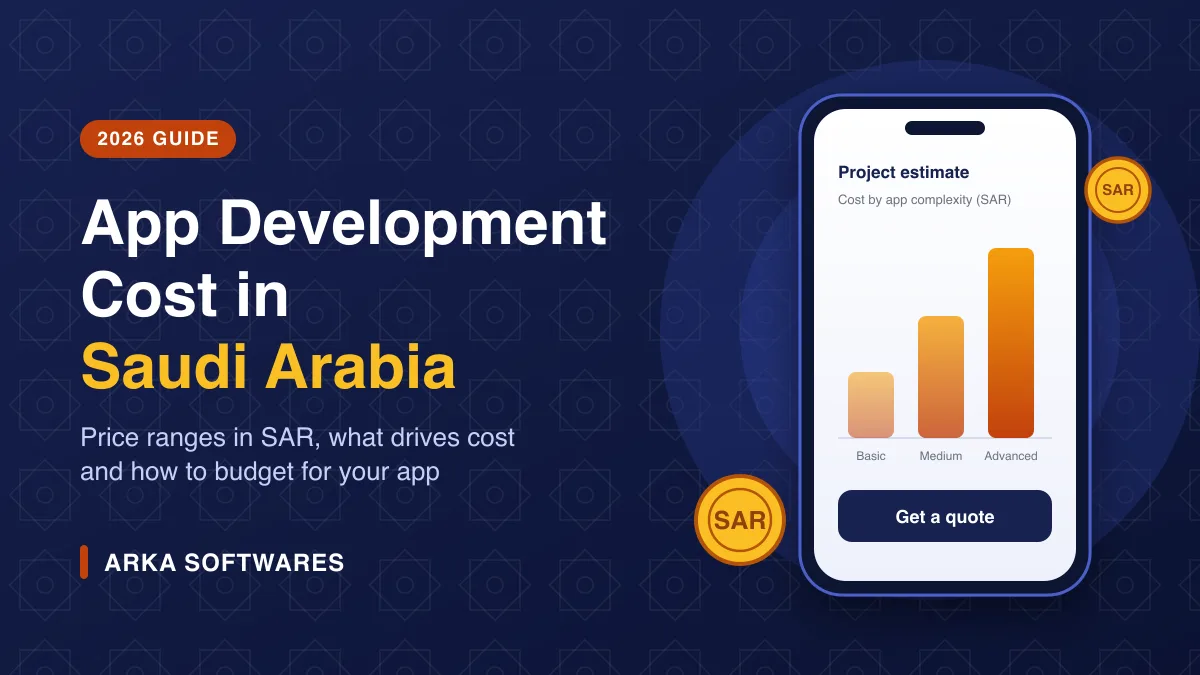
App development cost in Saudi Arabia depends on scope, integrations and compliance needs, and Saudi apps often need extras such as Arabic support and local payments. This guide explains the price drivers.
Short answer: a custom mobile app built for the Saudi market typically costs between SAR 34,000 and SAR 90,000 or more for a single platform, depending on features, integrations and compliance needs. Simple apps sit near the lower end. Apps with payments, multiple user roles, Arabic and English, or regulated features move toward and above the upper end. This guide explains what you are paying for and the Saudi-specific items that other cost guides leave out.
Key takeaways
Features, user roles and integrations decide the price far more than the industry.
Saudi apps usually need Arabic and English from day one, local payment methods such as mada, and sometimes Nafath, ZATCA e-invoicing or PDPL-aware data handling. These add scope that generic estimates do not include.
Budget for a post-launch period: maintenance, hosting, gateway fees and app store accounts.
Compare quotes on scope, not just price, and ask who owns the code.
Prices below are indicative and shown in SAR, with VAT at 15% shown separately.
Typical app costs in Saudi Arabia
App type | Typical scope | Indicative range (SAR, ex-VAT) | Typical timeline |
|---|---|---|---|
Basic app | A few core screens, login, simple admin panel, one platform | 34,000 to 45,000 | 2 to 3 months |
Medium complexity (ecommerce, booking, service marketplace) | Customer and admin apps, mada and card payments, notifications, 2 to 4 integrations | 57,000 to 90,000 | 3 to 5 months |
Advanced app (on-demand with live tracking, fintech, healthcare, AI features) | Multiple roles, real-time features, complex integrations, security and compliance work | 90,000 and above | 5 months or more |
Ranges are per platform. A cross-platform build (Flutter or React Native) for iOS and Android together is typically cheaper than two native apps.
What drives the cost
Platforms: iOS, Android, web admin, customer website.
Features and screens: profiles, search, chat, maps, wallet, loyalty, reviews, subscriptions.
User roles: customer, vendor, driver, admin each need their own interface.
Design: template-based UI versus custom design, motion and a full design system.
Integrations: payment gateways, SMS, WhatsApp, CRM and ERP, maps, identity.
Backend and hosting: scalability, security, and where data is stored.
Language and layout: Arabic right-to-left (RTL) layouts alongside English.
Compliance: data protection, e-invoicing and sector rules.
Saudi-specific costs to plan for
Arabic and RTL. Real RTL layouts, Arabic typography and content, and testing on both languages. Planning this at the start is much cheaper than retrofitting it.
Local payments. Saudi customers expect mada, Apple Pay and STC Pay, and many also use buy-now-pay-later providers such as Tabby and Tamara. Gateways such as HyperPay, Moyasar and PayTabs charge their own setup and per-transaction fees, which are not part of the development cost. Check each provider's current pricing page for their fees.
Identity and verification. Some apps need Nafath or other Saudi identity verification flows. Access depends on the identity provider's onboarding process and the type of business. Confirm the current requirements with the provider.
E-invoicing (ZATCA). Apps that issue invoices, such as ecommerce, delivery and services, may need to work with ZATCA's Fatoora e-invoicing requirements. Confirm the current phase and requirements with ZATCA or your accountant.
Data protection (PDPL). The Saudi Personal Data Protection Law, supervised by SDAIA, affects consent, storage and cross-border transfers. Ask your legal adviser what applies to you, and ask the developer how the app handles consent, encryption and data location. Consider in-Kingdom hosting where your sector or customers require it.
Cybersecurity expectations. Government-linked and enterprise clients may expect alignment with NCA controls, which adds review and documentation work. Whether it applies depends on the client and the sector.
VAT. Saudi VAT is 15%. Check whether quotes are shown with or without VAT.
Addresses and maps. Delivery and field-service apps may need National Address or short-address lookups.
What it costs after launch
Ongoing cost | What it covers | Typical budget |
|---|---|---|
Maintenance and updates | OS updates, bug fixes, small improvements | Typically 15 to 20% of build cost per year |
Hosting and infrastructure | Servers, database, storage, monitoring, in-Kingdom hosting if required | Depends on traffic and the hosting plan |
Third-party services | SMS, email, maps, push notifications, gateway fees | Varies with usage |
App store accounts | Apple Developer Program and Google Play Console | See Apple and Google for current fees |
Marketing and acquisition | Not part of development | Plan separately |
Where the money goes: a sample split
For a medium-complexity app, development time is typically spread roughly like this. This is a rough guide: the split varies with each project.
Phase | Share of the budget |
|---|---|
Discovery, requirements and planning | 5 to 10% |
UI and UX design | 10 to 15% |
Development (app and backend) | 45 to 55% |
Testing and quality assurance | 10 to 15% |
Project management, launch and store submission | 10 to 15% |
What Saudi clients say about working with us
Two clients in Saudi Arabia have shared feedback on projects we delivered. One, who commissioned a tutoring platform, said it met expectations with minor bugs, and that our team handled API issues proactively and worked in a milestone-driven way. Another, whose company ordered a mobile app, said internal stakeholders were pleased with its functionality and performance, and that we managed the project effectively with frequent documentation and progress check-ins. See more on our Saudi Arabia mobile app development page.
How to get an accurate quote
Write a one-page brief: who the users are, the three main journeys, and your must-have features.
Decide platforms and languages (Arabic, English or both).
List integrations you already know you need (payments, identity, ERP).
Ask for a feature-by-feature estimate with a timeline, and ask what is not included.
Confirm who owns the source code and design files.
Ask about support after launch and how bugs and changes are handled.
Ways to control cost
Launch an MVP with the smallest set of features that proves demand.
Use a cross-platform framework where native-only features are not needed.
Phase integrations: launch with the most important payment method and add others later.
Reuse tested modules for login, payments and notifications.
Next steps
See how we work on our Saudi Arabia mobile app development page, explore our Dubai team, or share your brief through the contact page.
Frequently asked questions
How much does it cost to make an app in Saudi Arabia?
Most custom business apps fall between the ranges in the table above, depending on scope. Get a feature-by-feature estimate for an accurate figure.
Is it cheaper to build an app in Riyadh than in Jeddah?
Agency pricing does not depend on the city. Cost depends on scope, team model and integrations.
Do I need an Arabic version of my app?
For most consumer apps in Saudi Arabia, yes. Arabic and English support should be planned from the start.
How long does it take to develop an app in Saudi Arabia?
Most business apps take two to six months from kickoff to store launch.
Can you integrate mada, Apple Pay and STC Pay?
Yes. We integrate these through Saudi payment gateways, and the right mix depends on your customers and settlement needs.
Do you work with Saudi companies from outside the Kingdom?
Yes. Arka serves Saudi clients from its Dubai office and through remote delivery, with scheduled calls, demos and written progress updates.